MYDG.HUB › Guides

Lithium and sodium-ion batteries by air: classification and labelling guide

By air, a battery shipment is classified in three steps: the cells must have passed the UN 38.3 tests; then it matters whether the battery travels alone, packed with equipment or inside it; and finally its size in watt-hours (lithium-ion, sodium-ion) or grams of lithium (lithium metal). That gives the UN number, packing instruction, section, labels and limits per package.

✓ Reviewed by an ADR Dangerous Goods Safety Adviser · Updated: 04/10/2026

Step 1 — UN 38.3: the test every cell must pass

Every lithium and sodium-ion cell or battery type must pass the UN 38.3 test series (altitude, temperature, vibration, shock, short circuit, impact, overcharge, forced discharge). Manufacturers and distributors must make the test summary available. Without it, the battery can only fly with a special state approval (special provision A88).

Step 2 — How to calculate watt-hours

The watt-hour rating decides the branch for lithium-ion and sodium-ion. It is usually printed on the battery; if not, calculate it:

  • Wh = V × Ah (nominal voltage × rated capacity)
  • If only mAh is shown: mAh ÷ 1000 = Ah
  • Example: 3.7 V × 4.4 Ah = 16.3 Wh
  • Lithium metal is measured in grams of lithium, given by the manufacturer.

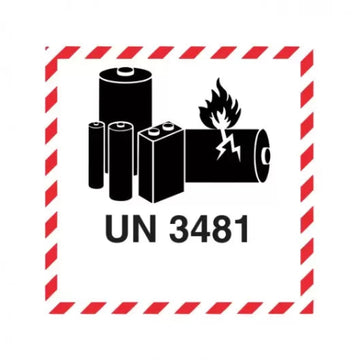
Lithium-ion (UN 3480 / UN 3481)
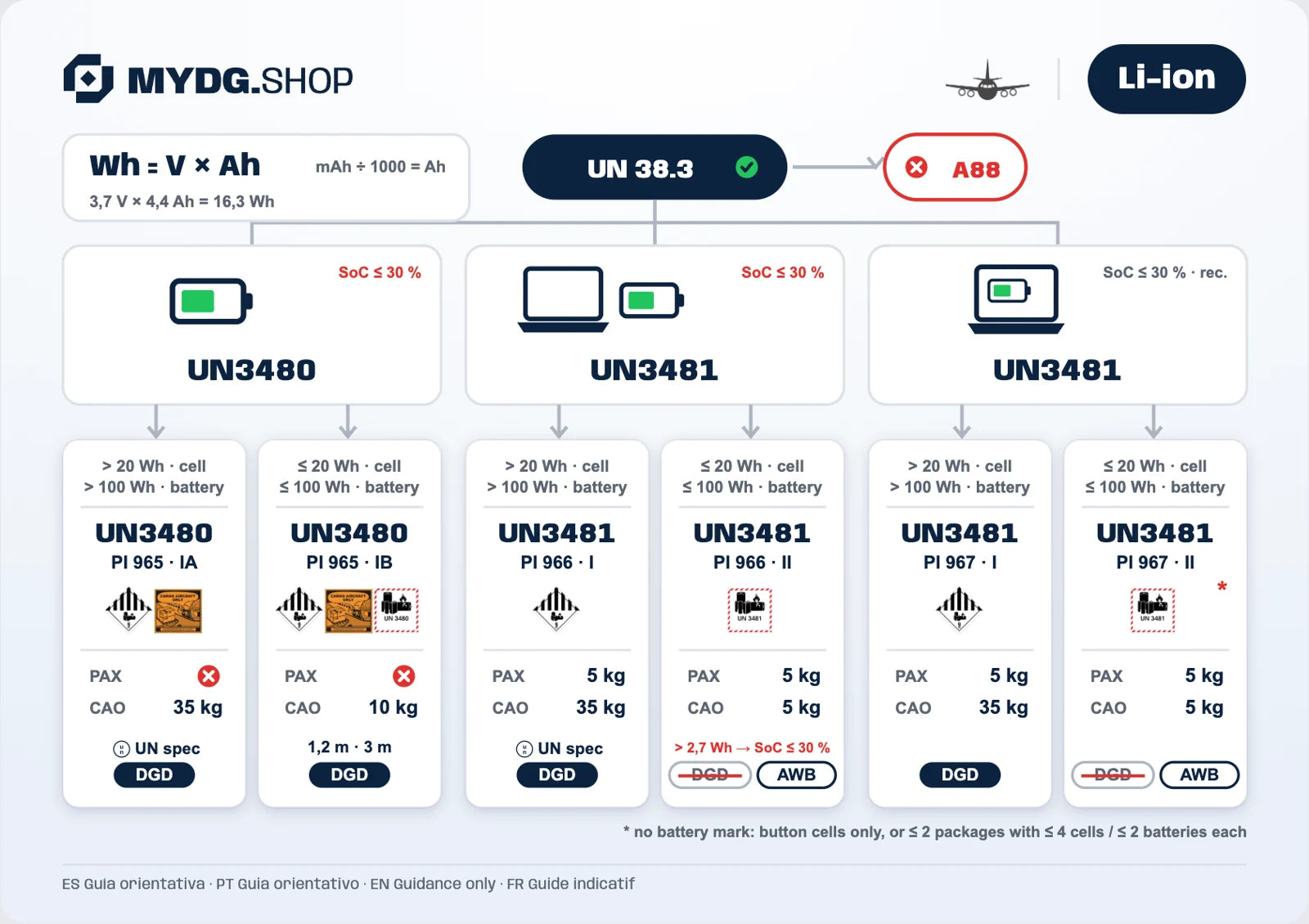
Lithium-ion classification flowchart
CaseUNPacking instructionLabels / marksPassengerCargo onlyDGD
alone, > 20 Wh / > 100 Wh3480PI 965 IA9A + CAOforbidden35 kgyes
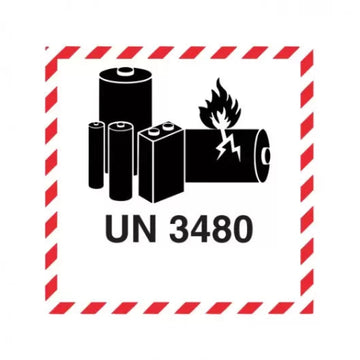
alone, ≤ 20 Wh / ≤ 100 Wh3480PI 965 IB9A + CAO + battery markforbidden10 kgyes
packed with equipment, > 20 / > 100 Wh3481PI 966 I9A5 kg35 kgyes
packed with equipment, ≤ 20 / ≤ 100 Wh3481PI 966 IIbattery mark5 kg5 kgno — AWB statement
contained in equipment, > 20 / > 100 Wh3481PI 967 I9A5 kg35 kgyes
contained in equipment, ≤ 20 / ≤ 100 Wh3481PI 967 IIbattery mark *5 kg5 kgno — AWB statement
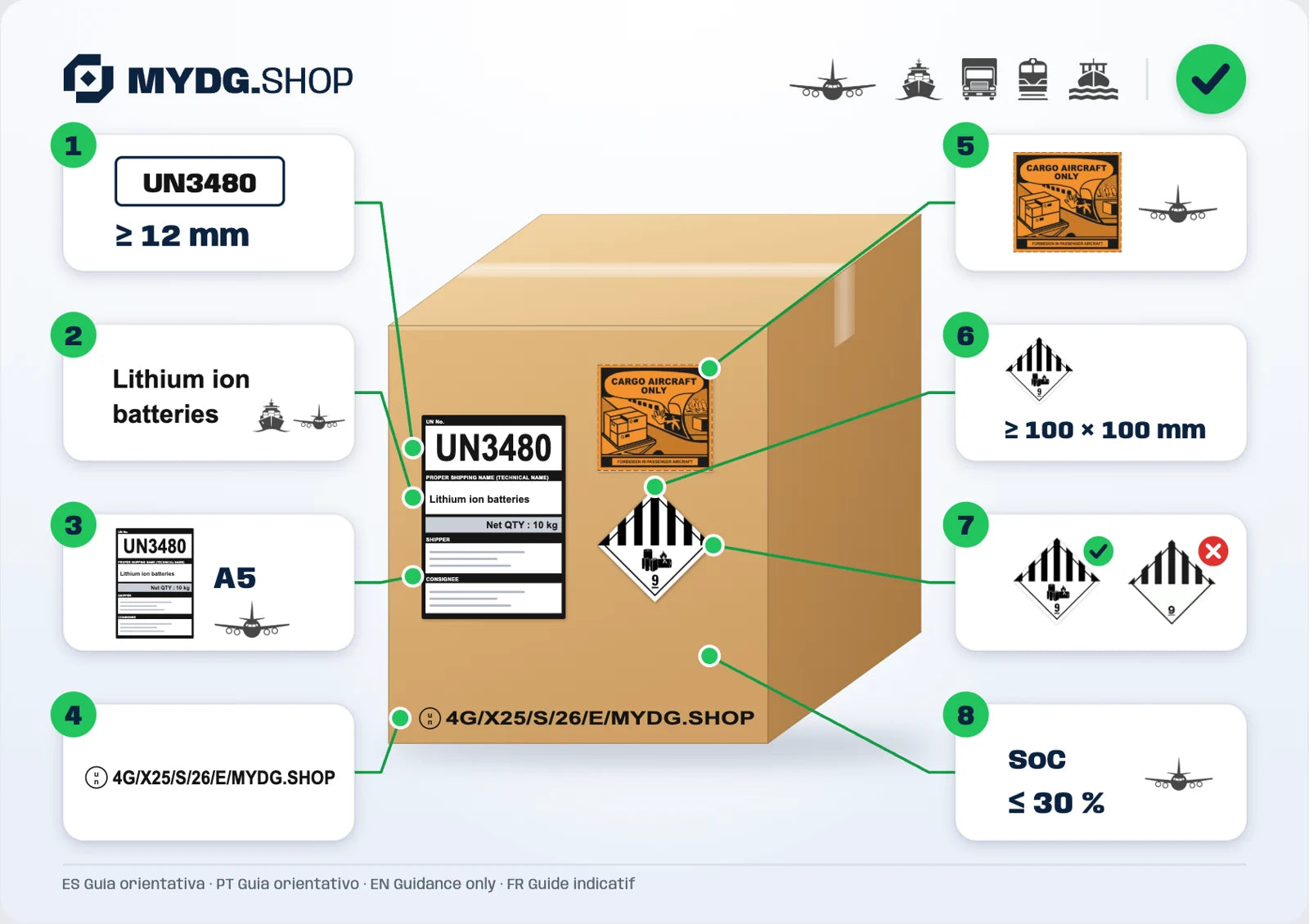
Correctly marked UN 3480 lithium-ion battery box

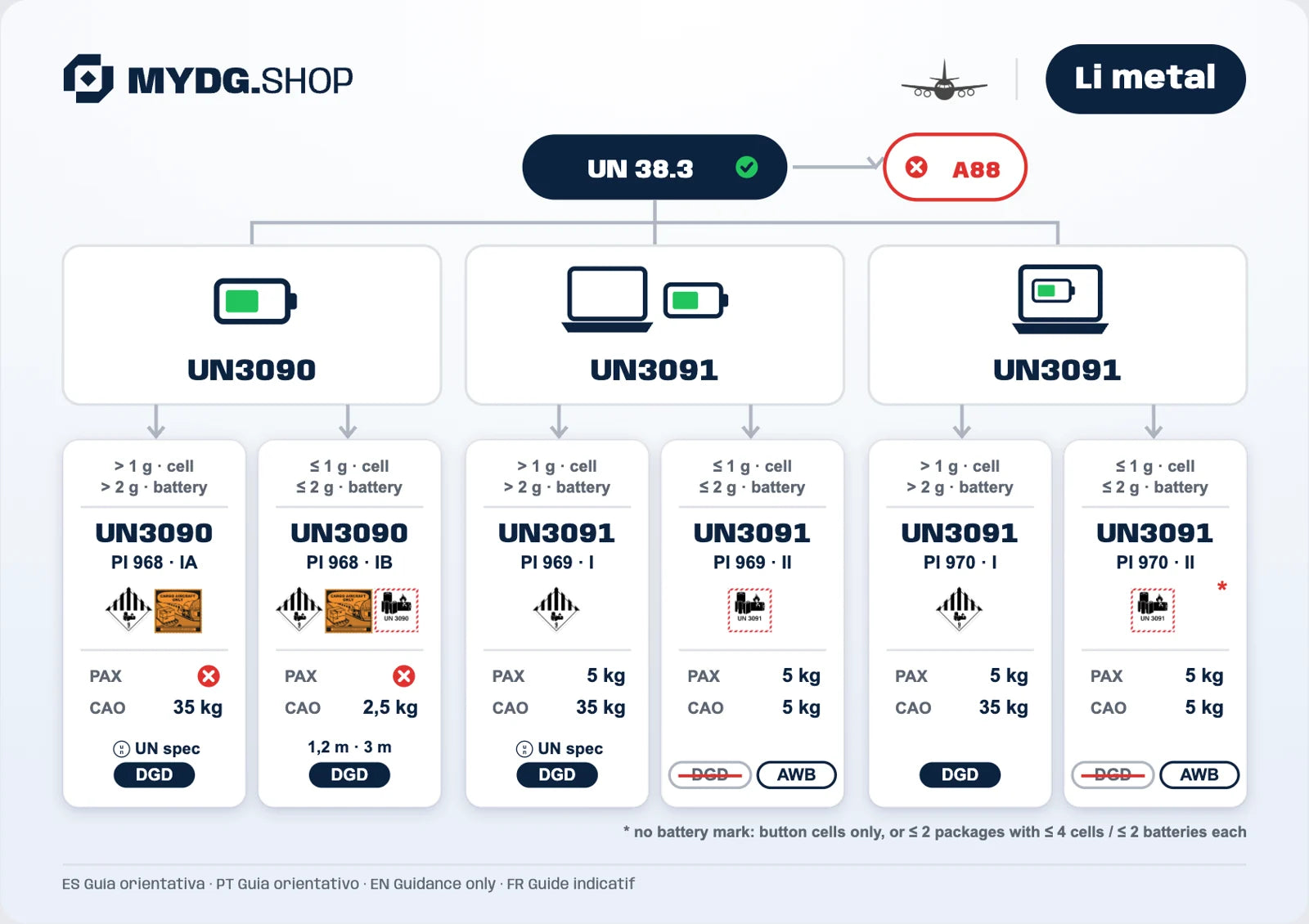
Lithium metal (UN 3090 / UN 3091)

Lithium metal classification flowchart
CaseUNPacking instructionLabels / marksPassengerCargo onlyDGD
alone, > 1 g / > 2 g3090PI 968 IA9A + CAOforbidden35 kgyes
alone, ≤ 1 g / ≤ 2 g3090PI 968 IB9A + CAO + battery markforbidden2.5 kgyes
packed with equipment, > 1 g / > 2 g3091PI 969 I9A5 kg35 kgyes
packed with equipment, ≤ 1 g / ≤ 2 g3091PI 969 IIbattery mark5 kg5 kgno — AWB statement
contained in equipment, > 1 g / > 2 g3091PI 970 I9A5 kg35 kgyes
contained in equipment, ≤ 1 g / ≤ 2 g3091PI 970 IIbattery mark *5 kg5 kgno — AWB statement
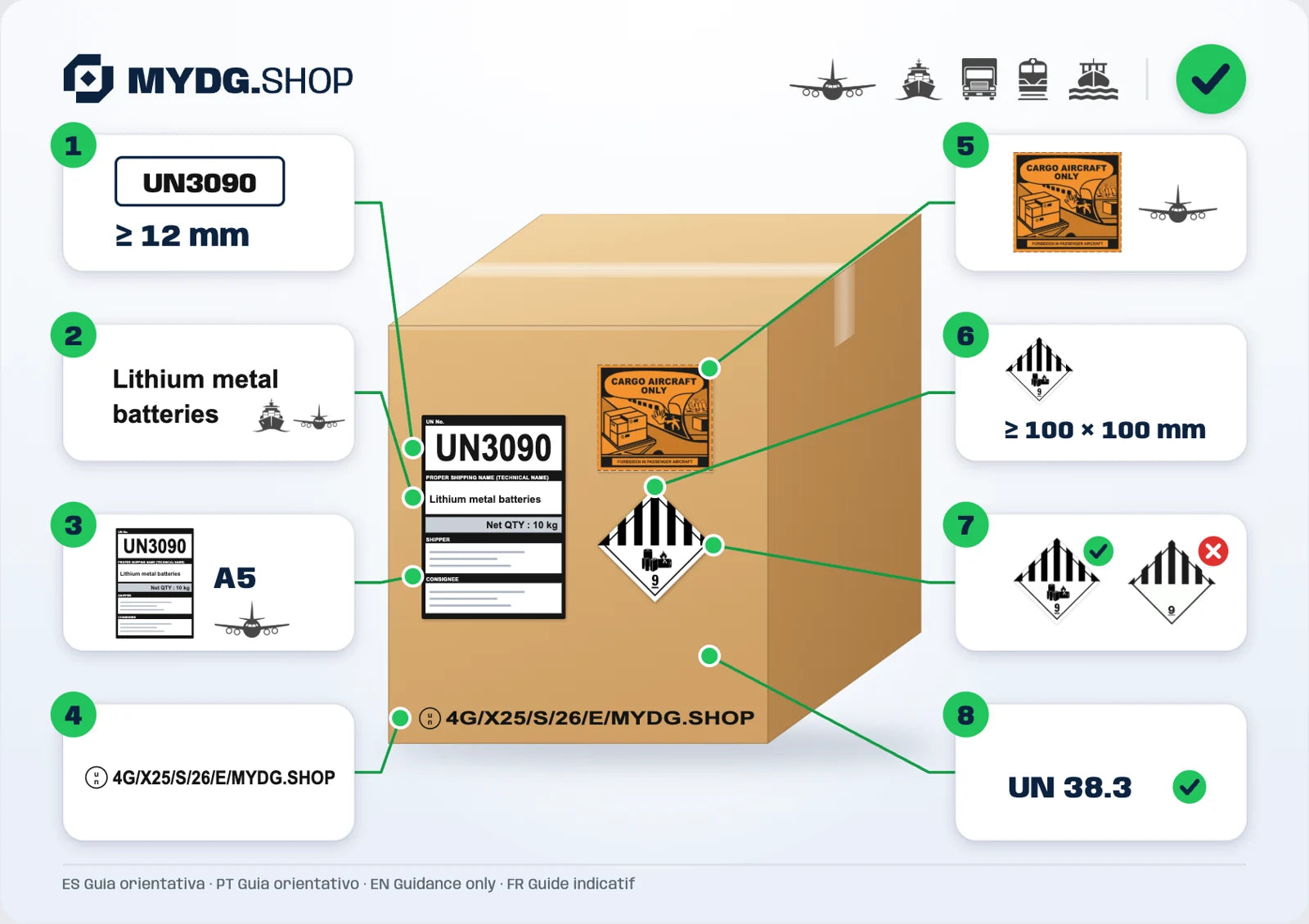
Correctly marked UN 3090 lithium metal battery box

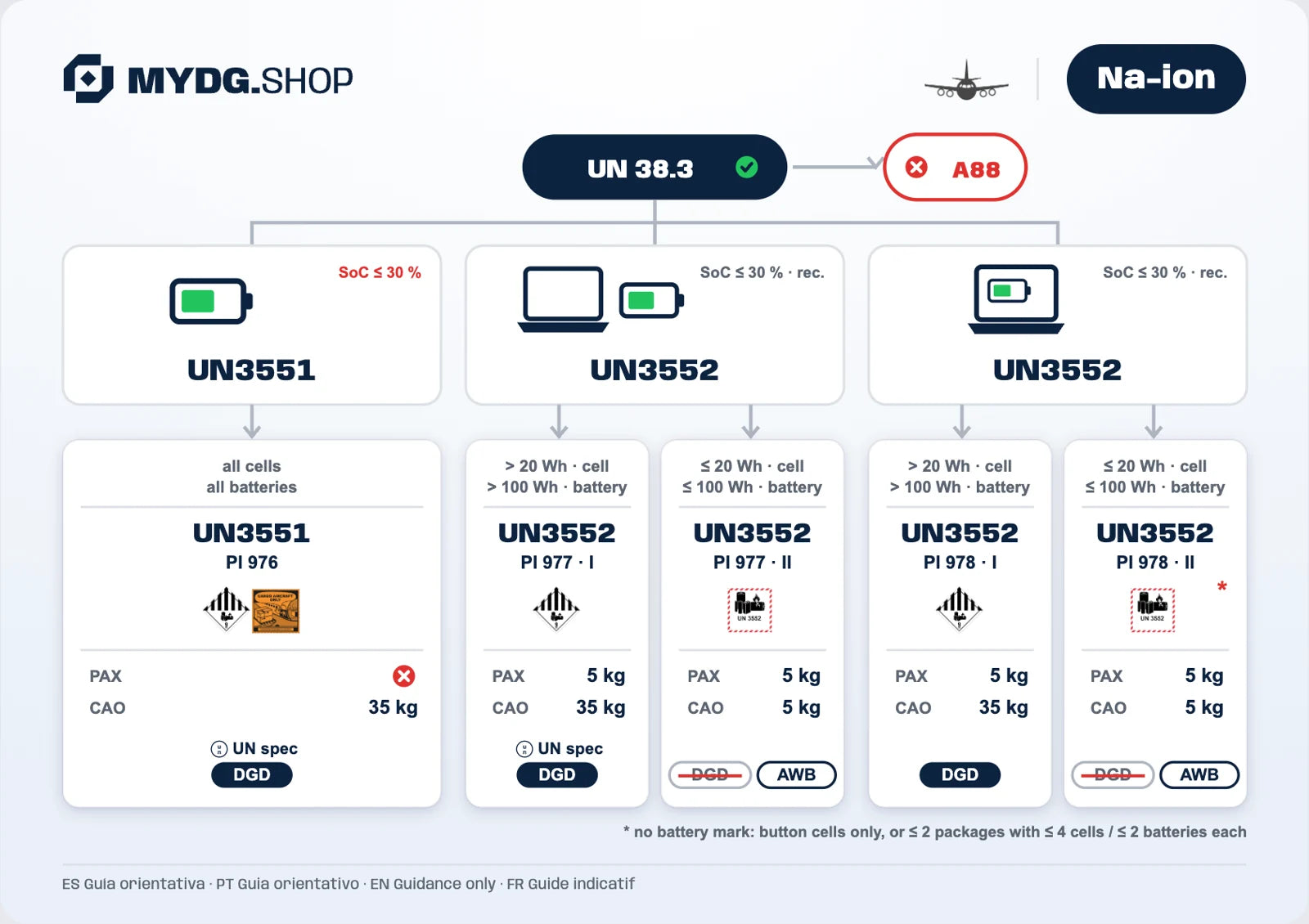
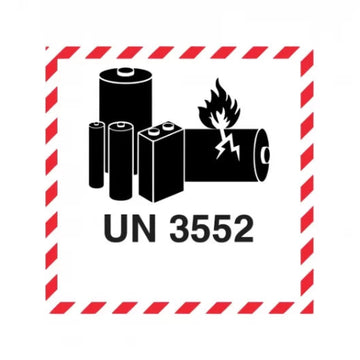
Sodium-ion (UN 3551 / UN 3552)

Sodium-ion classification flowchart
CaseUNPacking instructionLabels / marksPassengerCargo onlyDGD
alone3551PI 9769A + CAOforbidden35 kgyes
packed with equipment, > 20 / > 100 Wh3552PI 977 I9A5 kg35 kgyes
packed with equipment, ≤ 20 / ≤ 100 Wh3552PI 977 IIbattery mark5 kg5 kgno — AWB statement
contained in equipment, > 20 / > 100 Wh3552PI 978 I9A5 kg35 kgyes
contained in equipment, ≤ 20 / ≤ 100 Wh3552PI 978 IIbattery mark *5 kg5 kgno — AWB statement
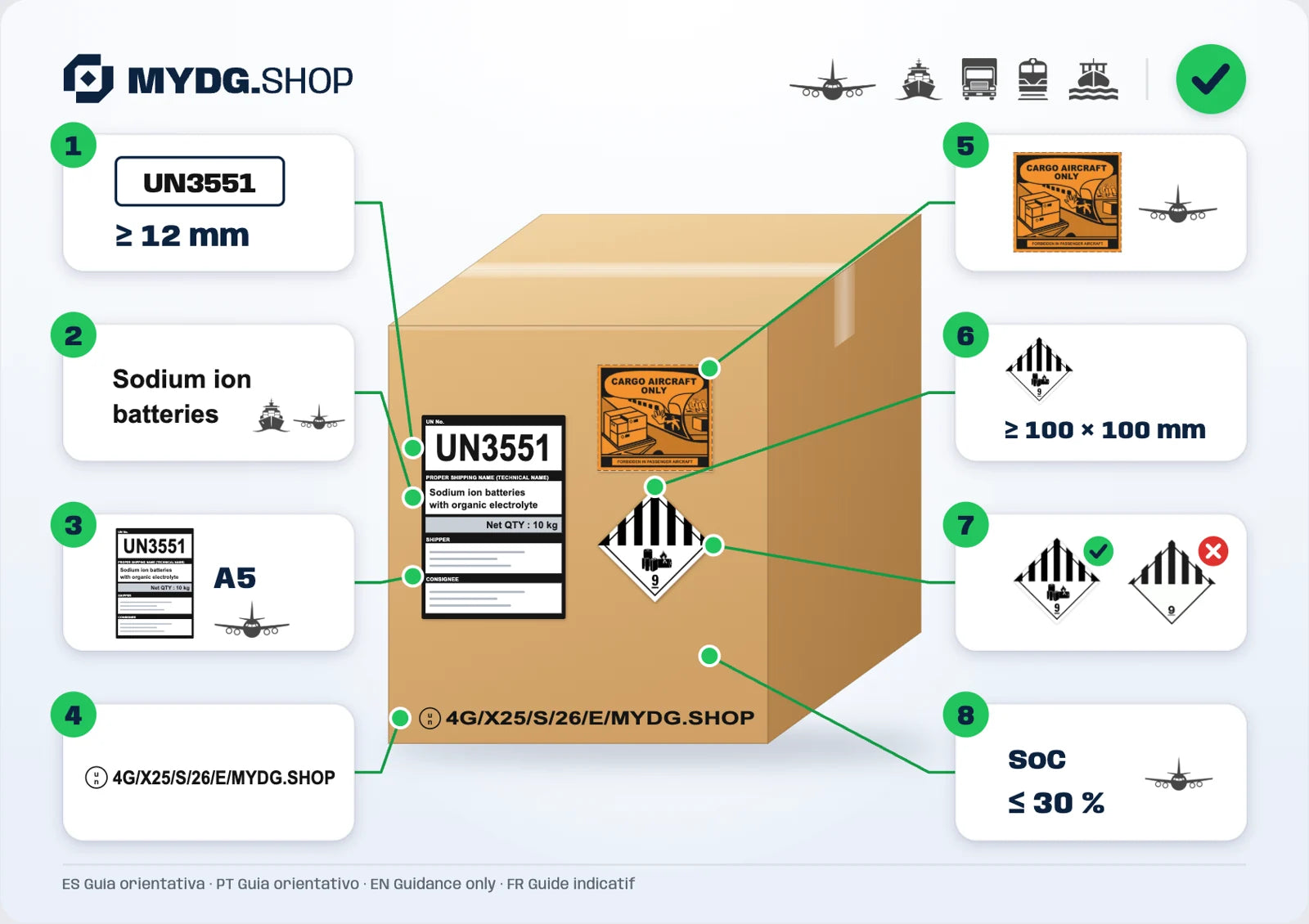
Correctly marked UN 3551 sodium-ion battery box

* Section II contained in equipment: no battery mark is needed for packages with button cells only, or for consignments of up to 2 packages with no more than 4 cells or 2 batteries each. Section II packages travel without a DGD; the air waybill carries the compliance statement, e.g. «lithium ion batteries in compliance with Section II of PI 966».

State of charge (SoC) — 2026 rules

  • Lithium-ion alone (PI 965): at most 30 % SoC — mandatory.
  • Lithium-ion packed with equipment (PI 966): at most 30 % SoC, mandatory since 1 January 2026 (Section II: for batteries above 2.7 Wh).
  • Lithium-ion contained in equipment (PI 967): 30 % (or 25 % indicated capacity) recommended.
  • Sodium-ion alone (PI 976): at most 30 %; with or in equipment (PI 977/978): recommended.
  • Above 30 % only with the approval of the State of origin and the State of the operator. There is no SoC certificate: the shipper vouches for it by signing the DGD — ask the manufacturer for written confirmation.

The correct box — 8 points

  1. UN number (≥ 12 mm).
  2. Proper shipping name, e.g. «Lithium ion batteries».
  3. Marking label: UN number, name, net quantity in kg, shipper and consignee.
  4. UN packaging mark — Section IA, Section I and PI 976 need certified packaging.
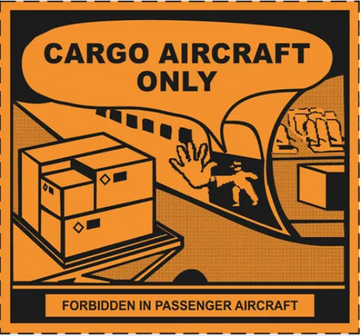
  5. Cargo Aircraft Only label for batteries shipped alone (forbidden on passenger aircraft).
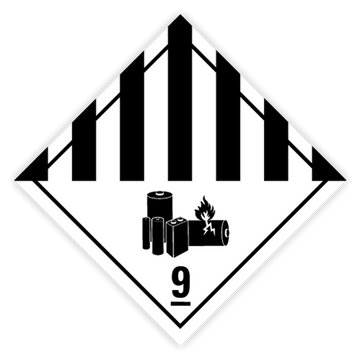
  6. Class 9A lithium battery hazard label (≥ 100 × 100 mm) — not the plain class 9.
  7. The battery mark does not replace the 9A label on fully regulated batteries.
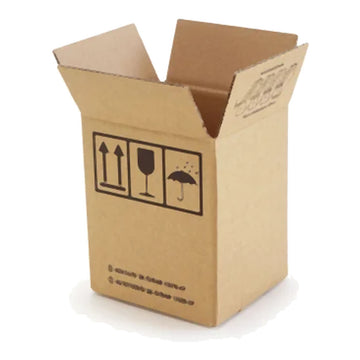
  8. No orientation arrows: batteries are not liquids.

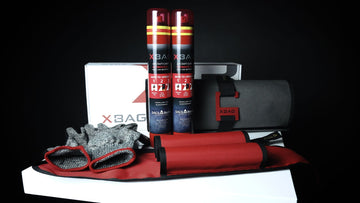
Products for this shipment

Available at MYDG.SHOP.

Download the guide (PDF, print-ready A6)

Viewing is free. To download the PDF, leave your email: we send you a personal link (valid 14 days).

Frequently asked questions

What is UN 38.3?

It is the series of eight safety tests in the UN Manual of Tests and Criteria (sub-section 38.3) that every lithium and sodium-ion cell and battery type must pass before it can be transported. The manufacturer must make the test summary available.

How do I calculate the watt-hours of a battery?

Multiply nominal voltage by capacity in ampere-hours: Wh = V × Ah. If the battery only shows mAh, divide by 1000 first. Example: 3.7 V × 4400 mAh = 3.7 × 4.4 = 16.3 Wh.

Can lithium-ion batteries shipped alone (UN 3480) go on a passenger aircraft?

No. UN 3480 under PI 965 Section IA and IB is forbidden as cargo on passenger aircraft and must carry the Cargo Aircraft Only label.

Is the 30 % state of charge mandatory?

For lithium-ion batteries shipped alone, yes. Since 1 January 2026 it is also mandatory for lithium-ion batteries packed with equipment (Section II only above 2.7 Wh). For batteries contained in equipment, and for sodium-ion with equipment, it is recommended.

Who certifies the state of charge?

Nobody issues a separate certificate. The shipper vouches for it by signing the Dangerous Goods Declaration; the manufacturer sets the charge level, so ask for written confirmation.

Battery mark or class 9A label?

The battery mark is for Section II (and Section IB, together with 9A and CAO). Fully regulated batteries (Section IA and Section I) need the class 9A hazard label; the mark never replaces it.

Do Section II shipments need a Dangerous Goods Declaration?

No. Section II packages travel without a DGD; when an air waybill is used, it must show the compliance statement, for example «lithium ion batteries in compliance with Section II of PI 967».

Guidance only. It does not replace the regulations in force: the consignor classifies the goods, decides and signs. MYDG.SHOP SL · Badajoz (Spain).